 Concrete Answers Series for Architects, Engineers and Developers |


Inspection and Maintenance
Pervious Concrete Pavement Maintenance and Operations Guide (PDF)
Construction Inspection and Testing
Normal construction inspection practices that base acceptance on slump and cylinder strengths are not meaningful for pervious concrete. 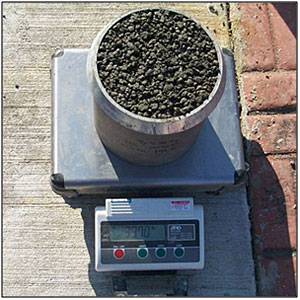 Strength is a function of the degree of compaction, and compaction of pervious concrete is difficult to reproduce in cylinders and a method has not been standardized. Instead, a unit weight (density) test of fresh pervious concrete is usually used for quality assurance, with acceptable values dependent on the mixture proportions. The unit weight of pervious concrete generally varies between 100 lb/ft³ and 125 lb/ft³ (1600 kg/m³ and 2000 kg/m³).
Density of fresh pervious concrete should be tested in accordance with ASTM C1688 – Standard Test Method for Density and Void Content of Freshly Mixed Pervious Concrete. Testing frequencies of once per day, or when visual inspection indicates a change in the concrete, are common. Acceptance criteria typically are plus or minus 5 lb/ft³ (80 kg/m³) of the target value established during the process of designing the pervious concrete mixture. The measured density of fresh pervious concrete provides a means of estimating the void content of the mixture when consolidated in a standard manner in accordance with ASTM C1688. It will not represent the void content that will be in the installed pavement that might receive different compactive effort.
ACI 522.1-13: Specification for Pervious Concrete Pavement, recommends placing two test panels on the project site, on a subgrade and subbase prepared as specified, using the material and construction requirements for pavement per the project specifications. Each panel must have an area of at least 225 ft2, and a width and thickness as specified for the pavement in the project’s Contract Documents. Density of the fresh concrete, hardened density of cores and length of cores should be recorded, as these will be used as reference points for quality assurance and acceptance.
Post-Construction Inspection and Testing
After seven days, core samples can be taken (per ASTM C 42) and measured for thickness and density (unit weight) as quality assurance and acceptance tests. A typical testing rate is three cores for each 100 yd³ (75 m³). Compression testing for strength is not recommended, because of the dependence of compressive strength on compaction. Densities, in accordance with ASTM C 1754: Density and Void Content of Hardened Pervious Concrete, provide an acceptance measurement; typical requirements dictate that average density be within 5% of the density of cores obtained from the accepted test panels. The common criterion for acceptance of thickness is that no core shall be under the design thickness by more than 3/4 in. (19 mm) and the average length of three cores shall be between -3/8 inch and + 1 ½ inches (-10 mm and 38 mm). It should be noted that pervious concrete pavements may have a higher variability in pavement thicknesses when placed on an open graded subgrade, compared with conventional concrete pavements.
Questions have been raised about the freeze-thaw durability of pervious concrete. Although most early experience with pervious concrete was in warmer climates, there are now numerous pervious concrete projects in colder climates as well. Pervious concrete in freeze-thaw environments must not become fully saturated. Saturation of installed pervious concrete pavement can be prevented by placing the concrete on a thick layer of 8-24 inches (200 to 600 mm) of open-graded stone base. Limited laboratory testing has shown that entrained air may improve the freeze-thaw durability even when the pervious concrete is in a fully saturated condition. However, the entrained air content cannot be verified by any standard ASTM test procedure. Laboratory testing has also shown that the inclusion of small amounts of fine aggregate improved strengths and freeze thaw durability without sacrificing the total void content. Other options include installation of a perforated pipe in the aggregate base layer which will help in preventing the pervious concrete system from becoming fully saturated. Proper maintenance of the pervious concrete can also play an important role in its freeze-thaw durability.
Maintenance
The majority of pervious concrete pavements function well with little or no maintenance. However, after repeated water flows, debris and residue may lodge within the top 1” to 1 ¼” of the void structure. Maintenance of pervious concrete pavement consists primarily of removing this debris and residue from the void structure to rejuvenate some of its original permeability. In preparing the site prior to construction, drainage of surrounding landscaping should be designed to prevent flow of materials onto pavement surfaces. Soil, rocks, leaves, and other debris may infiltrate the voids and hinder the flow of water, decreasing the utility of the pavement. Landscaping materials such as mulch, sand, and topsoil should not be on the concrete, even temporarily.
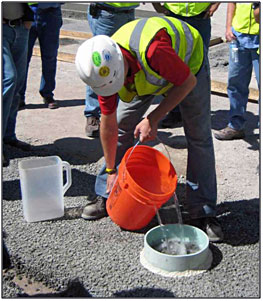
A specific frequency for maintenance cannot be stated because of differences in site conditions, water flow and traffic. One recommendation is to evaluate the permeability of the pavement immediately after construction using ASTM C1701 – Standard Test Method for Infiltration Rate of In-Place Pervious Concrete. Perform the test in several locations to establish a benchmark, and re-test at similar locations after a period of service to evaluate the rate of clogging of the pavement with time. This can be used as a basis to set a pavement maintenance schedule for that site.
Vacuuming annually or more often may be necessary to remove debris from the surface of the pavements. For best results over a large area, a regenerative vacuum sweeper should be used. Other cleaning options may include power blowing and pressure washing. Research has shown that using any of these methods to clean a clogged pervious concrete pavement can restore 80% to 90% of the original permeability in some cases.